An evening clutch that will not sit closed is not a closure problem. It is a structure problem that becomes visible at the closure.
A flap that does not sit flush, a body that sags at the base, a front panel that feels soft when the bag is held, a corner that creases differently on one side than the other — these are the complaints that turn a good-looking evening bag into a return. And they are almost always decided at specification, long before anyone assembles the bag.
The short answer
Structure quality in an evening clutch comes from four things, in this order of importance:
- The internal support panel — the rigid layer that carries the shape, its material and its thickness
- Panel alignment — whether the internal layers are cut and positioned consistently from unit to unit
- Edge finishing — the fold, paint and seal on the edge, which is where alignment errors become visible
- The closure interface — how closure components are fitted to a structure that has already been built
If the first two are wrong, the last two cannot correct them. That is why structure problems appear across a whole run rather than in a few units.
What buyers mean by “structure problems”
The complaint and the cause are rarely the same thing:
- “It will not close properly” — often a support panel thickness or closure fitting tolerance, not the closure itself
- “It does not hold its shape” — support panel material, thickness, or the way it was bonded
- “The corners look different” — panel alignment, and how the internal layers were cut
- “It looks cheap” — edge finishing and surface, which is where structural inconsistency shows
- “The flap has lost its crispness” — the face material and the molding or interlining process
- “It arrived creased” — packing, but often a structure or support issue as much as a packing issue
What is actually inside an evening clutch
The structure is not a single part. A structured clutch is a layered build: an outer face material, an internal support panel that carries the shape, and a lining. Each layer has a thickness and a tolerance, and those numbers — not the design — determine whether the finished bag holds its form.
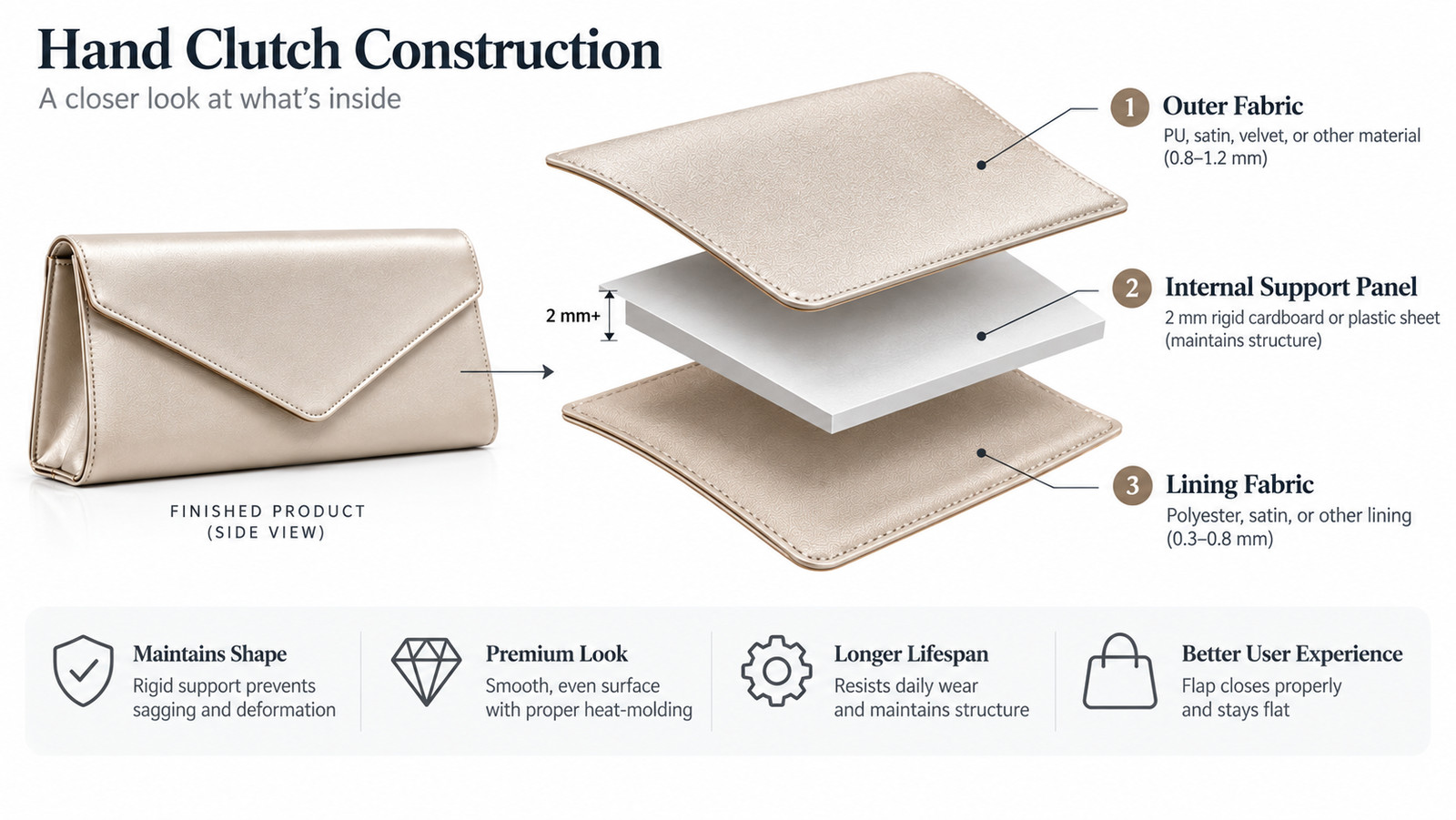
Where the face material is soft, the support panel has to do more work. Where the design has a sharp fold, the panel has to take that fold without cracking. Where the closure is a metal frame, the panel has to be thick enough to hold it without distorting. These are decisions about the inside of the bag, and they are made before the outside is finalized.
Where structure quality is decided
- Support panel material specification and thickness tolerance
- Cutting tolerance for the internal layers
- Bonding or molding process, and the cure or dwell time it requires
- Alignment standard for panels, edges and closure position
- Edge finishing standard — fold, paint and seal, and the acceptable finish of each
- Closure fitting tolerance, measured rather than judged by eye
None of these is a design decision. All of them are specification decisions, and they are the reason two suppliers can quote the same design and deliver two different products.
Why the closure is a structure problem
Turn-lock, magnetic, frame and flap closures all fail in the same way when the structure is wrong: the components themselves are within tolerance, but the panels they are fitted to are not, so the gap appears at the closure. Adjusting the closure does not solve it. Panel thickness, alignment and fitting tolerance are the variables.
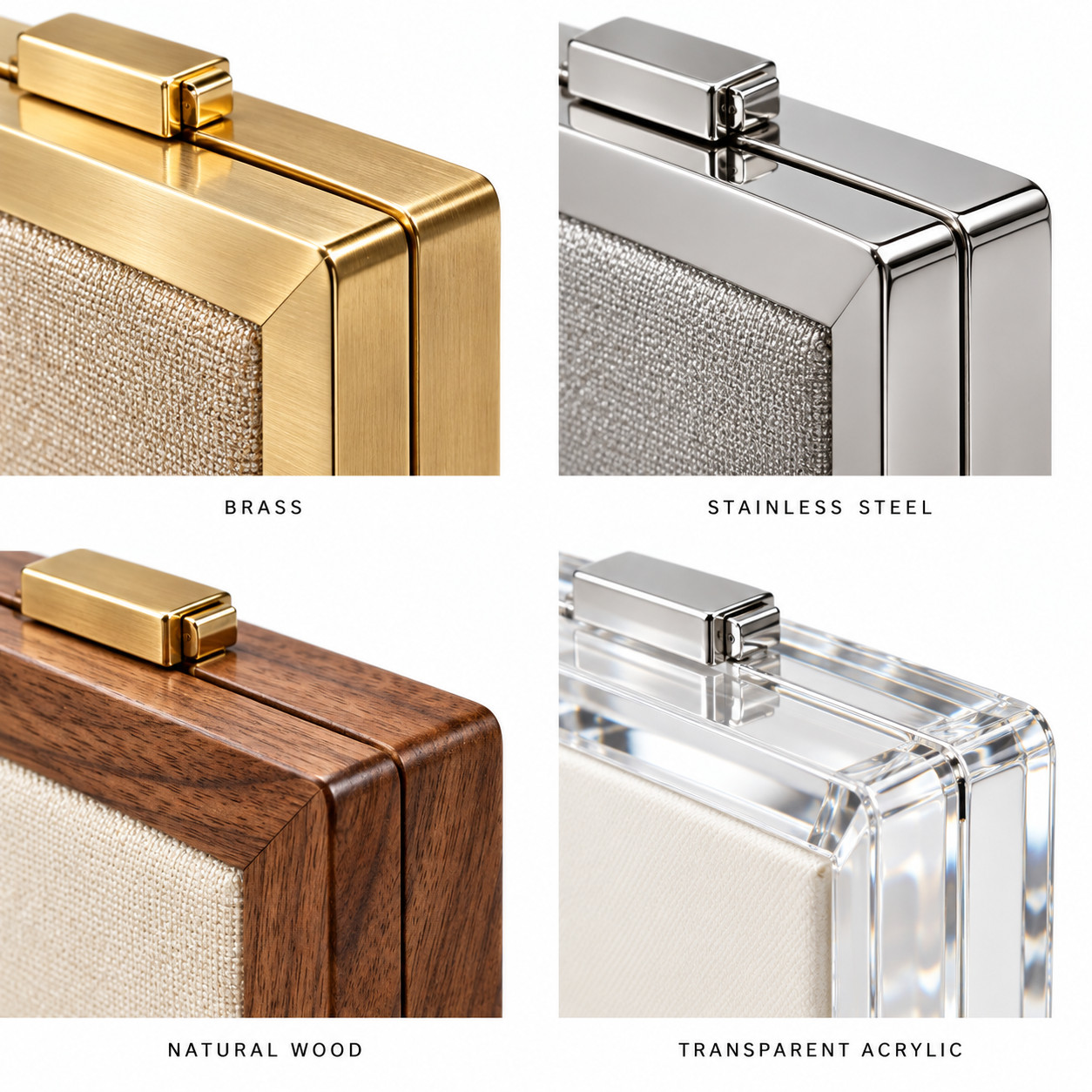
It is also the failure that a photograph will not show. A sample can look correct in an image and still be out of tolerance in the hand, which is why structure has to be approved against measurements rather than appearance.
How to evaluate a supplier’s structure capability
Structure quality is one of the few things that can be assessed before an order exists, because it depends on documentation rather than on goodwill. Ask for:
- The material specification and thickness tolerance for the support panel
- Measurement tolerance standards for panel alignment and closure gap
- A written checklist used at each stage, not only at final inspection
- Defined failure criteria — what counts as a reject, expressed as numbers
- Good and poor examples from previous production, shown side by side
- A method for scoring the first production run against the approved sample

A supplier who cannot produce these documents before sample approval is unlikely to produce them during production.
Why structured evening bags are a category decision
Structured clutches are less forgiving than soft bags. A hobo or a tote can lose a little shape and still work. A box clutch or a framed evening bag either holds its form or looks wrong, and the tolerance for variation is much smaller.
That is why structure work is not a general handbag capability. It needs the support material, the molding process and the inspection standard to be specified together, by someone who has produced the category before.
How SOCCI develops structured evening bags
Evening bags are one of SOCCI’s core categories. On a structured style, the internal build is fixed before the design is finalized: support panel material and thickness, alignment tolerance, edge finishing and closure fitting are specified as part of the product, and the sample is approved against a written measurement standard that the first production run is then checked against.
Where a design cannot hold its structure at the target retail price, the first checks are the panel material, the construction and the process — before the design is simplified or the standard is reduced.
Send us a style or a reference image and we will tell you what the structure build should be. Discuss your next collection.
Related reading: why beads fall off evening bags, and handbag factory vs design and sourcing partner.