Embellished evening bags tend to fail in a specific way. They pass inspection, they photograph well, they arrive looking correct — and then the beads begin to come away, after the product has already reached the customer. By the time the problem is visible it is no longer a production issue. It is a return, a complaint and a review.
That is why embellishment quality is judged differently from hardware quality, and why it has to be specified before the sample is approved rather than checked after the goods are packed.
The short answer
Beads and other decorative elements come away for four reasons, and only the last of them is a production problem:
- The attachment method was chosen for cost rather than for load. Adhesive alone is the most common cause. It is also the cheapest to specify and the hardest to see in a photograph.
- The thread, tension or stitch pattern was not matched to the weight of the embellishment. A heavy bead on a fine thread behaves differently from a light one.
- The base material cannot carry the embellishment. On a soft or stretchy face fabric, the beads and the fabric move differently, and the attachment works itself loose.
- Finish QC checks appearance rather than attachment. Visual inspection at packing is precisely the check that does not catch this failure.
Why embellishment failures are judged differently from hardware failures
When a clasp or a zip fails, a customer concludes that the product is faulty. When the embellishment fails, they conclude that the brand is cheap. The second judgment is harder to recover from, because it is about perceived value rather than function — and on an evening bag, the embellishment is usually the reason the product was bought.
Where embellishment quality is actually decided
Embellishment is often treated as a decorative step added near the end of production. In practice, four decisions are made long before that, and they determine whether the embellishment holds:
- Attachment method — sewn, glued, or sewn and glued, and specified per embellishment type rather than per style
- Thread and tension — thread type, stitch pattern and tension, matched to the weight of the bead or stone
- Base material — whether the face material can carry the weight and movement of the embellishment without distorting
- Load distribution — how weight is spread across a panel, and what happens where embellishment meets a seam, an edge or a closure
Handmade does not mean uncontrolled
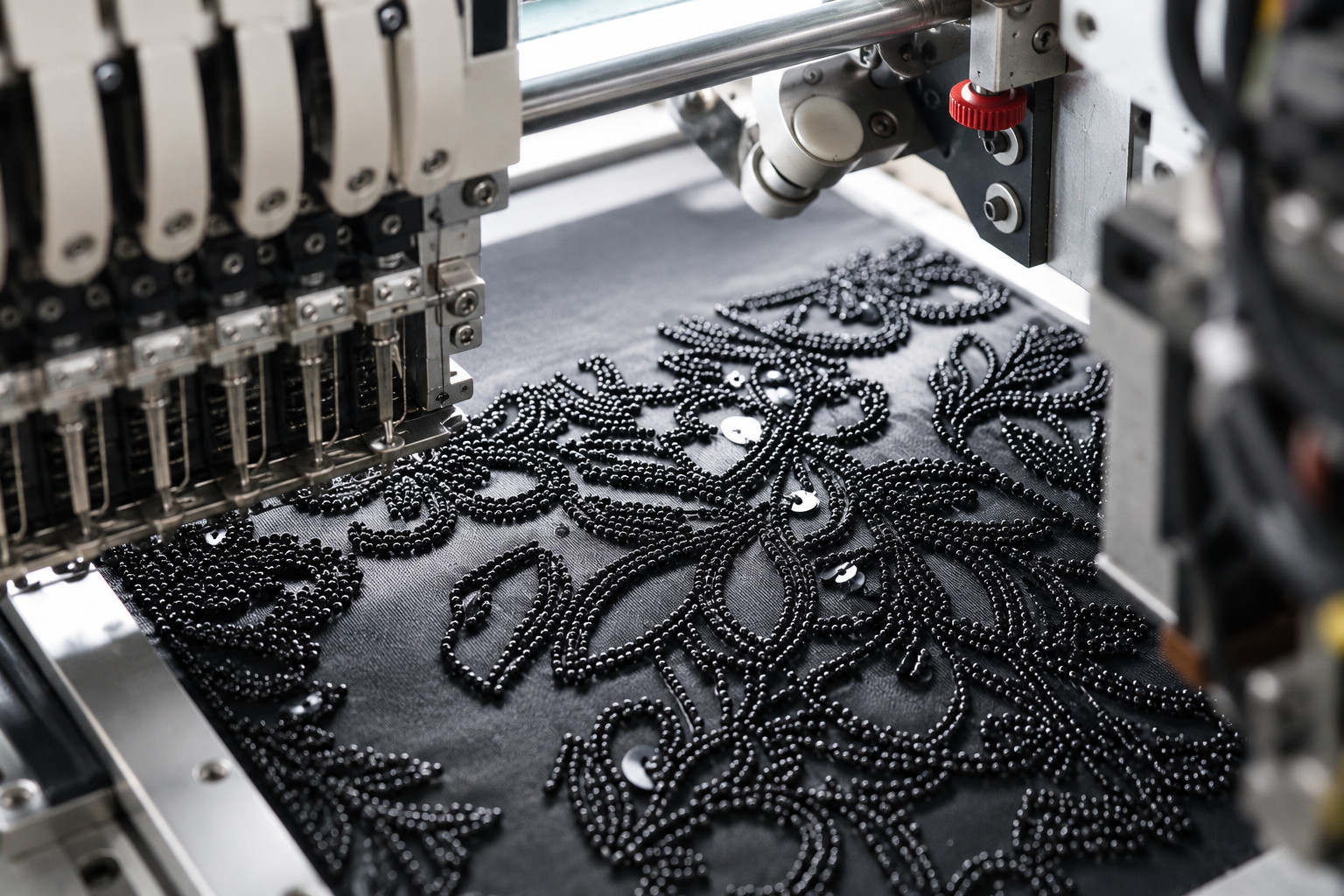
Embellished work involves hand processes, and hand processes produce variation. That is not the same as accepting variation. Natural variation exists, but unnecessary variation can be reduced through method, tension, hand technique and size and gap standards — and once those are written down, a second production run can be compared against the first.
What an embellishment quality protocol should cover
- Attachment method specified per embellishment type, not per style
- Thread type, stitch pattern and tension specified in the sample file
- Adhesive type and cure specified wherever adhesive is used at all
- Adhesion and pull checks treated as a separate step from visual inspection
- The base material tested against the weight of the embellishment before the style is approved
- Edge and seam finishing checked where embellishment meets a structural line
- A written sample standard, so that production is measured against it rather than against memory

What to ask before you approve an embellished sample
- How is this attached — sewn, glued, or both? Is the same method used for every embellishment on the style?
- What thread and what tension are specified?
- Has this face material been used with embellishment of this weight before?
- How is adhesion checked, and at what stage?
- What is the accepted variation in size and spacing, and where is it written down?
- What does a reject look like in numbers, rather than in opinion?
How SOCCI develops embellished evening bags
Evening bags are one of SOCCI’s core categories, and in that category the work on an embellished style runs before the sample round. The embellishment is treated as a construction decision rather than a decoration added at the end: attachment method, base material, thread and finish standard are fixed together, and the sample is approved against a written standard that the production run is then checked against.
Where a design cannot meet its target retail price with the embellishment as drawn, the first moves are the attachment method and the base material — not the design, and not the standard.
Send us a style or a reference image and we will tell you what the embellishment build should be. Discuss your next collection.
Related reading: why evening bags lose their shape, and how to choose a handbag development partner.